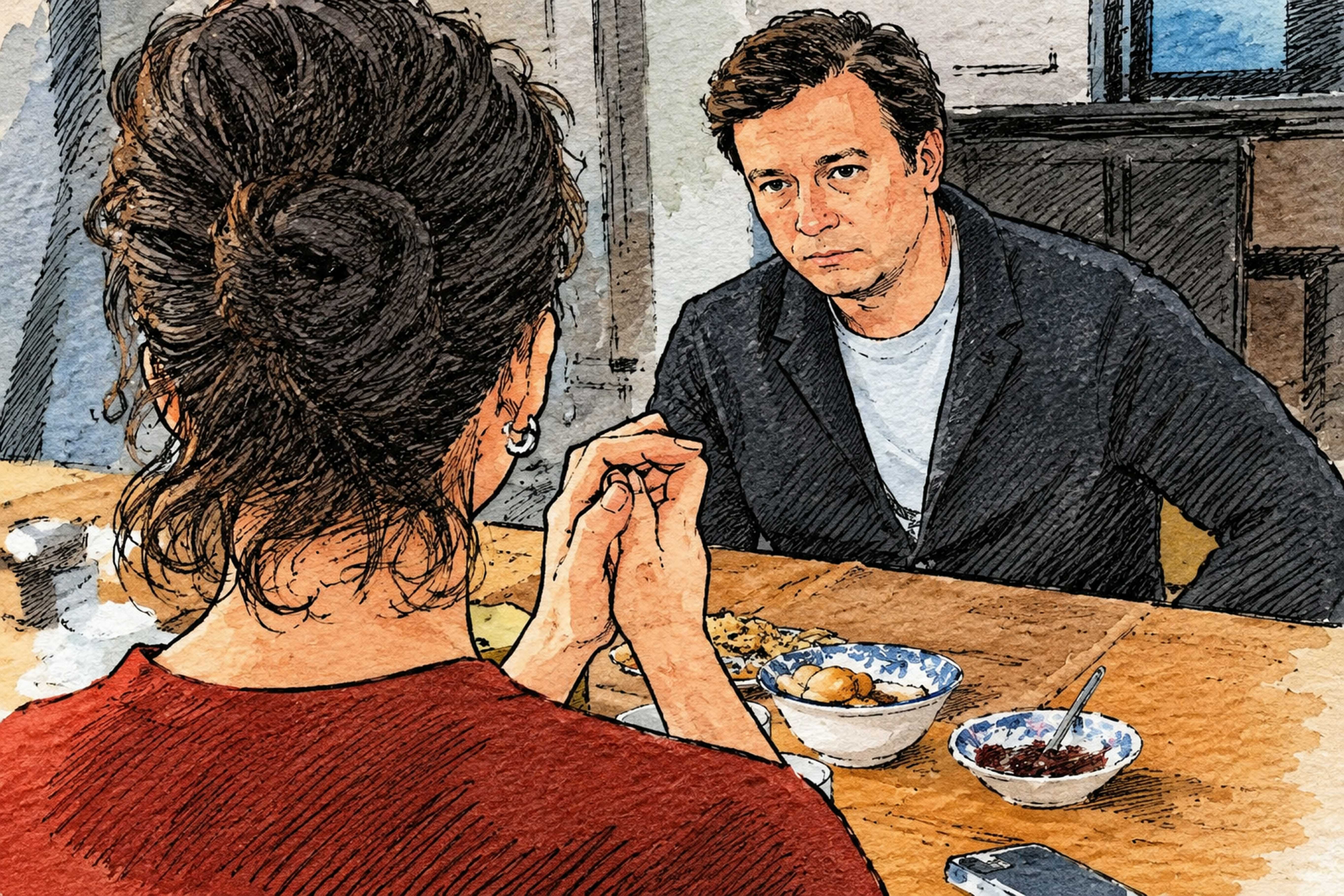

Gleb’s response to his wife’s suspected infidelity is not an attempt to repair their marriage. It is an investigation. A successful businessman who runs a logistics company in a provincial Russian city, he is accustomed to solving problems by gathering information, issuing instructions and keeping events within his control. When Galina begins making unexplained trips and exchanging messages that appear to amuse her, he turns the methods of his professional life toward his private one. He wants to know what she is doing. More than that, he wants to recover the authority he believes he has lost.
In Andrey Zvyagintsev’s “Minotaur,” that impulse becomes the starting point for a larger examination of power. Gleb’s marriage is deteriorating at the same time that the Russian state is demanding men from his company for the war in Ukraine. The two crises initially appear unrelated. One concerns betrayal between husband and wife; the other, the mobilization of workers by the government. But Zvyagintsev gradually brings them into the same moral frame. Both involve people who regard others as possessions, resources or obstacles to be managed. Both expose the ease with which control becomes a justification for violence.
The film is a loose adaptation of Claude Chabrol’s “The Unfaithful Wife” (1969), a French psychological thriller about a husband who discovers his wife’s affair and kills her lover. Zvyagintsev had considered remaking the film after completing “Loveless” in 2017. He was drawn to Chabrol’s treatment of observation and to a long, largely wordless sequence in which the husband kills his wife’s lover. He also saw an opportunity to develop a part of the original story that Chabrol had largely left aside: the husband’s professional life. At the time, however, there was no war in Ukraine to shape the adaptation. That changed in September 2022, when Russia announced its partial military mobilization. The political crisis gave the workplace story its central conflict, and Zvyagintsev and co-writer Simon Lyashenko brought the personal and political narratives together.
The story takes place in Krasnoborsk, a fictional Russian city, in the fall of 2022. Gleb and Galina live with their teenage son, Seryozha, in a modern house near a lake. Their surroundings suggest the security that Gleb’s business has afforded them, but the marriage has become emotionally remote. Galina is having an affair with Anton, a photographer whose modest apartment contrasts with the space and comfort of the family home. Gleb’s suspicions are eventually confirmed. Yet the film does not present him as a betrayed husband whose own conduct has been beyond reproach. Galina reminds him of his previous affairs. Their marriage has been shaped by mutual injury, but the power each possesses within it is unequal.
Gleb does not approach his wife as someone whose trust he might have to regain. He watches her, investigates her movements and tries to establish what she has concealed. The camera reinforces this pattern of observation. Characters are often seen through windows or across spaces that separate them. The house, with its broad panes of glass, resembles a transparent enclosure: its occupants can watch one another, but proximity does not bring intimacy. Zvyagintsev has described the villa as a kind of aquarium. He extended that separation to other locations, including Gleb’s office, where events unfold across glass partitions and open-plan spaces.
The visual design makes surveillance more than a plot device. Gleb’s home and workplace are places where people can be observed without necessarily being understood. He has the resources to investigate his wife and the authority to direct employees. His professional habits follow him into domestic life, where he treats uncertainty as something that can be eliminated through information and intervention. Galina is not simply a victim of this arrangement. She has made choices that hurt her husband, and the film does not turn her affair into an uncomplicated act of liberation. But the two are not equally equipped to control what happens next. Gleb has money, institutional connections and people who can act on his instructions. Galina does not.
The marriage is only one of the problems confronting him. The mayor summons Gleb and several other local business leaders and tells them that the state needs men for the war. Each is expected to provide names for a military recruitment quota. The request comes from Moscow through the local government and is presented as an order, not a negotiation. The mayor tells the businessmen that they are not there to bargain. They must submit their lists by the following Thursday; if they do not, the state will begin taking men directly.
The demand arrives as Gleb’s company is already losing workers. Seven employees have left to avoid being called up, while others are considering leaving. At the office, staff watch footage of Russians trying to cross the border into Georgia. The scenes are among the film’s few direct glimpses of the mobilization’s effect on civilian life. For Gleb, the departures are both a business problem and a warning of what may happen to the people who remain.
The number demanded from him is fourteen. The film’s title invokes the Greek myth in which Athens must send fourteen young people into the labyrinth of the Minotaur as tribute to the creature. In Zvyagintsev’s contemporary version, the offering is made to the machinery of war. The workers are not selected because they have done anything wrong. They become expendable because the state requires bodies and the company has been ordered to supply them.
Gleb does not simply hand over the names of his existing employees. He devises another plan: recruit fourteen truck drivers by offering unusually high salaries, then place them on the list. The company’s human resources manager, Natalia, is unaware of the purpose behind the hiring. She succeeds in finding the recruits and proudly presents them to Gleb, believing she has solved a difficult staffing problem. He now has to look at the people whose names he intends to submit. Among them is a 21-year-old man whom he considers saving. But if he spares that recruit, someone else must take his place. The calculation offers no way out of the moral problem. It only changes who will bear its cost.
The plan protects the company’s established workforce and preserves Gleb’s business. It also shifts the danger onto people who have been recruited without knowing why their new jobs are available. Gleb is under pressure from the state, but he is not merely passing on an order without discretion. He chooses how to satisfy it. His decision turns recruitment into a form of sacrifice, with the people least able to protect themselves selected to absorb the consequences.
This is where the film’s political argument becomes most pointed. Gleb does not design the mobilization policy, and he cannot simply refuse the mayor’s demand. But his position gives him choices unavailable to the workers. He can devise a workaround, protect the business and decide which people will be exposed to the danger. The pressure he receives from above does not erase the power he exercises below. His company becomes a channel through which a state demand is translated into individual fates.
The contradiction is not that Gleb has no choices. It is that the choices he retains are largely directed toward protecting himself and his business. He cannot keep the state out of his company, but he can decide whose lives will be disrupted first. The fourteen names turn an abstract demand into a responsibility that can no longer be kept at a distance.
The Violence Behind the Arrangement
Gleb’s effort to preserve control over his professional life runs alongside a more direct act of violence at home. After discovering Galina’s affair, he goes to confront Anton. The encounter turns violent. In a state of emotional distress, Gleb strikes the photographer on the head with Anton’s own camera. The blow leaves him badly injured, but not dead. When Gleb realizes that Anton is still alive, he makes another decision: he throws him from the balcony. Zvyagintsev has distinguished the initial attack from what follows. The first act comes in an emotional frenzy; the decision to throw an injured man from the balcony is, in the director’s account, a fully conscious murder.
The distinction matters. Gleb’s violence does not remain an uncontrollable reaction to humiliation. He has an opportunity to stop, to seek help or to leave Anton alive. Instead, he chooses to kill him. The film does not excuse the decision by presenting it as the inevitable result of a failed marriage. Nor does it treat the murder as an isolated eruption that has nothing to do with the rest of Gleb’s life. The same desire to avoid losing control that shapes his response to Galina also informs his willingness to remove a person who has become an obstacle.
What follows is one of the film’s most consequential formal choices. Zvyagintsev devotes roughly 20 minutes to the disposal of Anton’s body, with almost no dialogue. The sequence follows Gleb through the practical work of concealing the crime. It is awkward, laborious and at times grotesquely comic. The duration denies the viewer the quick passage from violence to aftermath that a conventional thriller might provide. Instead, the camera stays with the consequences, making the physical work of concealment part of the moral experience of the scene.
The comedy is uncomfortable because it does not soften the murder. It exposes the absurdity of Gleb’s effort to restore order after an act that has destroyed it. The man who wants to manage every detail of his life now has to deal with a body that resists being treated as another problem to solve. The sequence also extends the film’s interest in observation. Zvyagintsev does not rush toward a dramatic revelation or rely on dialogue to explain Gleb’s state of mind. He makes the audience watch the actions themselves, including their clumsiness and duration.
The connection to the war is not that domestic murder and military violence are identical. Their scale, circumstances and victims are different. It is that both involve a chain of decisions whose consequences cannot be removed simply by refusing to acknowledge them. Gleb’s first attack on Anton is followed by a second, deliberate act. His recruitment scheme similarly requires him to move from receiving an order to selecting the people who will suffer its consequences. In each case, the decisive moment comes when he has to confront what his actions mean for another person.
The film’s treatment of the fourteen recruits makes that responsibility especially difficult to evade. Gleb would prefer not to see their faces. Natalia’s pride in her successful hiring makes that impossible. When he meets the new employees, they cease to be names on a list. The 21-year-old recruit makes the calculation more personal, but even the desire to spare him does not free Gleb from the decision. Saving one man would mean condemning another. The problem is not solved by choosing a more sympathetic victim. It is created by accepting the premise that someone must be sacrificed to protect the company.
The state’s demand is coercive, but Gleb’s response shows how coercion can be transmitted through institutions that are not themselves military. His company is a civilian business. Its workers were hired to drive trucks, not to fight in Ukraine. Yet the government’s demand changes the meaning of their employment. Their bodies become a resource that can be claimed by the state, while the employer becomes responsible for identifying who will be taken. The violence of mobilization begins before the recruits reach the front. It begins when their lives are converted into entries on a list.
The film also shows how the war remains present while much of civilian life continues around it. It appears in television reports, public symbols and the movement of men trying to leave the country before being called up. The conflict is rarely placed at the center of the frame. Zvyagintsev has said that this was deliberate: in the early months of the war, much of what was happening was hushed up and difficult to discuss openly. The war therefore unfolds at the edges of the story, yet its pressure reaches into the workplace and the family home.
That approach avoids turning “Minotaur” into a survey of Russian public opinion. Its characters do not represent every citizen facing mobilization, and the fictional Krasnoborsk cannot stand in for the entire country. The film concentrates on a narrower social group: prosperous local businesspeople whose economic interests depend on their relationships with officials. Their wealth does not place them outside the political system. It gives them a particular way of accommodating it.
The consequences of that accommodation become clearer when Gleb’s murder is investigated. Police officers find evidence that could expose him, but higher authorities instruct them not to pursue the case. The disappearance of Anton is absorbed into a society already accustomed to losing men to the war. The same political environment that forces Gleb to provide recruits also protects him from the ordinary consequences of murder. He is not brought to justice.
This is a crucial difference between Zvyagintsev’s film and Chabrol’s original. In “The Unfaithful Wife,” the husband’s crime eventually leads to his arrest, although the film leaves the wife’s response morally unresolved. In “Minotaur,” the investigation is stopped. The state does not merely demand sacrifices; its institutions also determine whose actions will be examined and whose will be overlooked. Gleb’s position within the local elite does not make him immune to pressure, but it helps insulate him from accountability when his interests align with those of the system.
The contrast also sharpens the film’s treatment of privilege. Gleb can be pressured by the mayor, but the workers he recruits cannot negotiate with him on equal terms. He can protect his existing employees by exposing newcomers to the draft. Later, he can escape punishment for a murder because the authorities refuse to pursue the evidence. The workers and Anton have no comparable protection. The unequal distribution of risk is not incidental to the story. It is the condition that allows Gleb to preserve his life as he has arranged it.
Zvyagintsev has explored the relationship between private life and political power in earlier films. “Leviathan” (2014) follows a man whose struggle over his home brings him into conflict with local authorities. “Loveless” (2017) begins with a marriage collapsing and a child disappearing while the adults remain absorbed in their own grievances. Both films connect domestic breakdown to failures in the wider society. “Minotaur” changes the position of its central character. Gleb is not simply someone crushed by an institution. He is also an intermediary who helps that institution carry out its demands.
That shift gives the film a more complicated account of responsibility. Gleb is neither the architect of the war nor a powerless bystander. His choices are constrained, but they are not absent. He cannot prevent the mobilization, yet he can decide whether to protect his business by recruiting people who do not know what awaits them. He cannot control the investigation into Anton’s death, but he benefits when the police are told to stop. The film’s criticism rests on the space between what Gleb cannot control and what he chooses to do with the power he still has.
Yet the film’s allegory is sometimes so explicit that it leaves little room for ambiguity. The number fourteen, the Minotaur reference and the portrait of Vladimir Putin in the mayor’s office make the political parallels difficult to miss. This clarity gives the story force, particularly for viewers unfamiliar with the details of Russia’s mobilization. But it also risks making the characters carry meanings that the film has already explained through its symbols. Anastasia Eleftheriou, writing in the East European Film Bulletin, argues that the film’s reliance on political allegory can confine it to a particular historical moment and narrow the range of possible interpretations. That is a fair reservation. The film is most compelling when its political argument emerges from the behavior of its characters and the construction of its images, rather than from symbols that announce their meaning in advance.
Its visual precision, however, gives the allegory a more unsettled dimension. The glass walls and windows keep people in view while separating them. The long takes allow actions to continue beyond the point at which a conventional film might cut away. Empty spaces and carefully composed frames make the characters appear isolated even when they share a room. These choices do not simply illustrate the theme of control. They shape the viewer’s experience of distance, observation and discomfort. Zvyagintsev’s camera watches the characters with the same patience that Gleb brings to his surveillance of Galina, but without granting him the authority to determine what the images mean.
The film was produced by France, Latvia and Germany and shot in Latvia, where the locations stood in for the fictional Russian city. Zvyagintsev had left Russia in 2021, before the full-scale invasion, and now lives in France. “Minotaur” won the Grand Prix at the 2026 Cannes Film Festival. France subsequently selected it as its entry for the 2027 Academy Award for Best International Feature Film. Those details place the film within an international production and distribution context, but they do not make it a direct account of every Russian experience of the war. Its perspective remains that of a filmmaker examining the compromises of a particular social class and the institutions that protect it.
The ending returns the story to the family. Gleb and Galina travel to Crete, the island associated with the myth of the Minotaur. Their apparent reconciliation does not resolve the violence that has preceded it. Their son, Seryozha, captures an image of the cloudy sky and turns it black and white. The clouds begin to resemble plumes of smoke rising from explosions. The image can be read as a reminder that the war remains present even when the family has placed distance between itself and the consequences. It also carries the trace of Anton, the photographer whose camera became the instrument of his murder. Through the son’s image-making, the dead man returns in a form that Gleb cannot simply dispose of.
The final image does not promise that Seryozha will escape his parents’ moral world. He is not responsible for their decisions, but he is growing up inside the family those decisions have shaped. The film leaves open what he will make of that inheritance. Its closing movement is less a declaration of hope than a refusal to settle the question of what the next generation will do with the world it receives.
The labyrinth in “Minotaur” is therefore not only a structure from which Gleb cannot escape. It is also a system he helps maintain. He can tell himself that the mayor gave the order, that the state left him no choice, or that the company had to survive. He can treat the murder as a private crisis and the recruitment list as a business problem. But the film places these actions beside one another until the distinctions he relies on begin to collapse. His effort to preserve his marriage, his company and his standing does not keep him outside the violence around him. It makes him one of its participants.
The people who pay the highest price are those who cannot arrange their way through the labyrinth: the workers whose names enter the recruitment lists, the man Gleb kills, and the families left to absorb the consequences. The journey to Crete offers no moral release. The family can leave the city, but the image of the clouds follows them. In Zvyagintsev’s film, power survives not only by issuing commands, but by persuading those who benefit from it that their own security is reason enough to pass the cost to someone else.
Leave a Reply