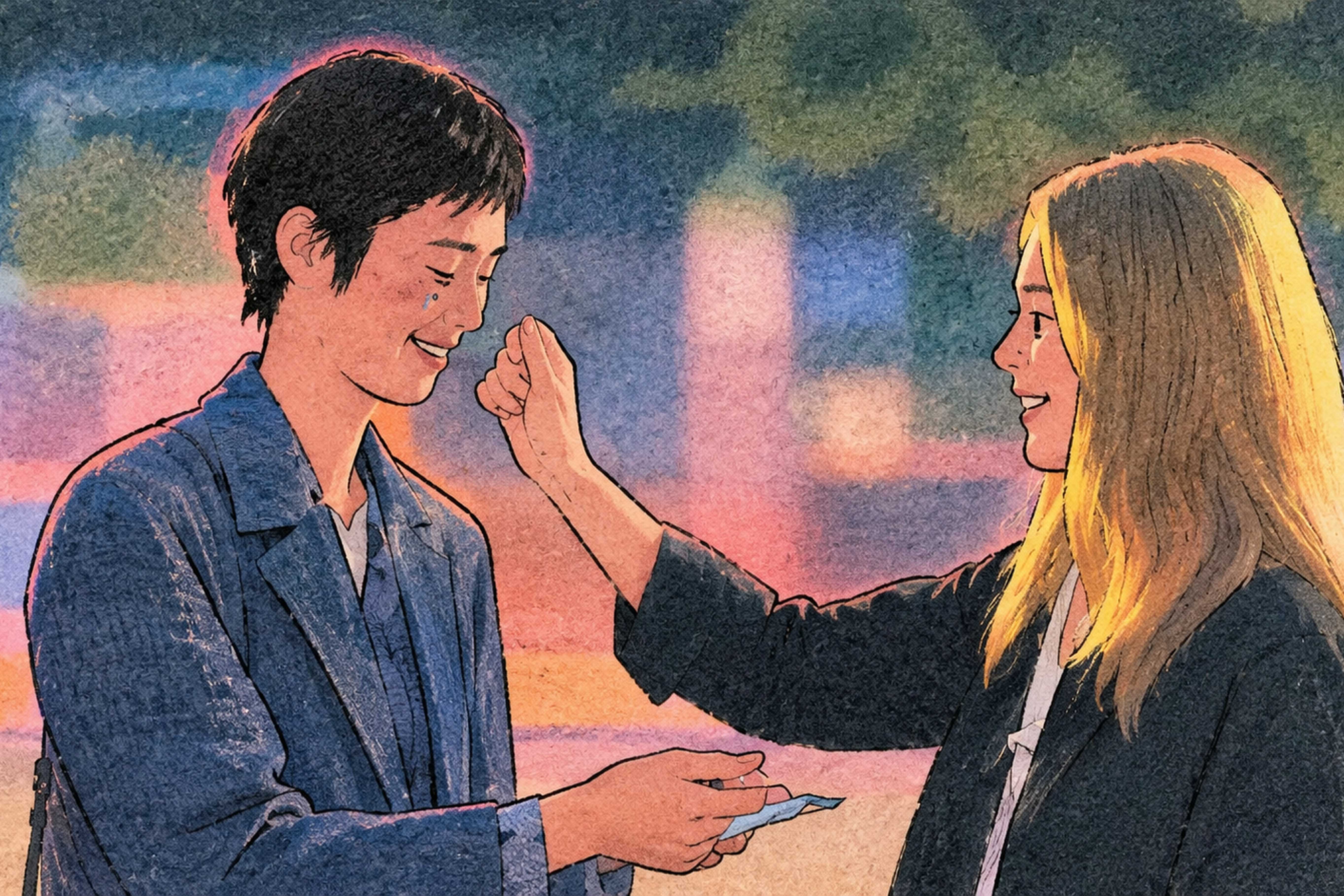

Conversation is one of cinema’s most familiar instruments. It can explain a character, advance a plot or establish a conflict. Yet it can also become something more difficult to define: an experience in its own right, shaped by pauses, misunderstandings, competing ideas and the gradual discovery of another person. In “All of a Sudden,” Japanese filmmaker Ryûsuke Hamaguchi makes conversation the organizing principle of a film that is less interested in what people say than in what becomes possible when they give one another the time to speak and listen.
Running 196 minutes, the film follows two women whose unlikely friendship brings together questions of elder care, political philosophy, mortality and the organization of modern life. Marie-Lou Fontaine, played by Belgian actress Virginie Efira, directs a residential care facility for older people in the suburbs of Paris. Mari Morisaki, played by Japanese actress Tao Okamoto, is a theater director visiting France. Their backgrounds are different, but both are preoccupied with the conditions under which people can live with dignity.
The setting is Garden of Freedom, a name that carries an almost deliberate contradiction. Freedom becomes difficult to define in a place where residents depend on institutional schedules, professional caregivers and procedures that regulate much of their daily existence. The facility is responsible for protecting people who may have lost some of their cognitive abilities, but protection itself can become restrictive when an institution begins to regard its residents primarily through their medical conditions and practical needs.
Marie-Lou wants to change that relationship. She is attempting to introduce Humanitude, a French approach to caregiving developed by Yves Gineste and Rosette Marescotti. Its central concern is the preservation of human dignity through communication, attention and physical interaction. The approach emphasizes four elements: looking at a person, speaking to them, touching them with consideration and helping them maintain an upright position. These practices are intended to preserve a person’s sense of identity and participation, particularly when dementia or other cognitive conditions make ordinary communication more difficult.
The distinction sounds straightforward. Its practical implications are not.
Introducing a different philosophy of care means changing established routines and asking workers to reconsider practices that may have defined their professional lives for years. Some employees resist the training. Others feel that the new requirements add to an already demanding workload. Sophie, an experienced nurse played by Marie Bunel, becomes one of the most prominent opponents of Marie-Lou’s initiative. Her resistance cannot simply be dismissed as indifference. She represents a professional perspective shaped by experience, established procedures and the practical demands of looking after vulnerable residents.
Olivier, Marie-Lou’s trusted colleague, played by Jean-Charles Clichet, also has to navigate the tension between the director’s ambitions and the facility’s daily operations. The institution cannot suspend its responsibilities while its employees learn a new method. Residents still need assistance, shifts must be covered and the work continues regardless of disagreements over management.
This conflict gives the film an important point of departure. A humane philosophy may offer a compelling answer to how people should be treated, but its implementation depends on circumstances that individual conviction cannot overcome. Training requires time. Workers need support. Institutions need sufficient resources. Without those conditions, a demand for more attentive care can become another obligation imposed on people who already have too much to do.
The film’s central relationship begins outside the care facility. Marie-Lou attends a theatrical performance featuring Goro, a senior actor played by Kyôzō Nagatsuka, who appears alongside his grandson Tomoki, played by Kodai Kurosaki. Tomoki is autistic and has substantial support needs. The performance, delivered in Japanese with French subtitles, addresses society’s treatment of people with cognitive disabilities and the importance of providing care without diminishing their humanity.
Afterward, Marie-Lou asks a question in Japanese. She has previously studied anthropology at a university in Tokyo, and her knowledge of the language allows her to speak directly with Mari. Their exchange develops beyond the usual discussion between an audience member and an artist. Mari reveals that she has terminal cancer and has already lived longer than her doctors initially expected.
When another audience member asks for her statement to be translated, Goro declines to intervene. He suggests that the seriousness of the exchange can be understood through the women’s voices.
The moment introduces one of Hamaguchi’s persistent concerns: communication cannot always be reduced to the accurate transfer of words. Language matters, but understanding also depends on attention, tone and the willingness to remain present when another person speaks. The film does not suggest that linguistic differences disappear through goodwill. Instead, it examines how people can establish a connection without having complete access to one another’s experiences.
The distinction becomes particularly significant because Marie-Lou and Mari largely speak their respective native languages. French and Japanese coexist throughout their conversations, with translation never entirely determining the relationship between them. Their exchanges challenge the assumption that communication must proceed through a single shared linguistic framework.
Hamaguchi gives these conversations considerable space. The women walk together through the grounds of the Bibliothèque nationale de France, discussing anthropology, education and the changing organization of society. Marie-Lou explains her academic interest in declining birth rates and ageing populations, connecting these developments to the growing dominance of work over private life.
Her argument concerns more than demographic statistics. Modern economic arrangements, she suggests, increasingly claim the time people might otherwise devote to relationships, families and activities beyond employment. Work becomes the organizing principle of everyday existence, leaving less room for the social connections that make life meaningful.
The argument acquires an immediate practical dimension when Marie-Lou receives a telephone call from the care facility. A shortage of staff means that she must cover a night shift. Rather than ending their meeting, she invites Mari to accompany her to work so they can continue talking.
The decision brings the film’s two principal worlds together. The discussion of capitalism and social organization enters the place where the consequences of institutional arrangements are experienced directly. Marie-Lou can speak about the importance of time outside work, but she cannot easily secure that time for herself. The shortage of employees makes her responsible for filling the gap.
At the facility, Mari takes over a whiteboard in an empty staff room and delivers an extended explanation of political economy. Drawing on her philosophical education at the Sorbonne, she discusses capitalism through the boundaries it creates: who is included in its structures, who is excluded and how the circle of those entitled to protection and participation can become progressively narrower. Her argument suggests that a system organized around increasingly restricted membership eventually undermines the conditions on which its own survival depends.
The scene is not an academic demonstration that settles the question of capitalism. Its importance lies in the way abstract ideas acquire a concrete setting. Mari is discussing a system of social organization inside a workplace struggling to provide adequate care. The institution’s difficulties are not simply the result of individual shortcomings. They are connected to the broader question of how society distributes time, labor and resources.
Hamaguchi’s intellectual references include Japanese feminist philosopher Chizuko Ueno’s Patriarchy and Capitalism and Nancy Fraser’s Cannibal Capitalism. Both works examine how economic and social arrangements depend on forms of labor and social reproduction that are frequently undervalued. Fraser’s argument is particularly relevant to the film’s treatment of care: economic activity depends on the maintenance of human life, yet the work that makes this possible is often treated as secondary to the market economy.
Care sustains people, maintains relationships and allows societies to reproduce themselves across generations. Yet it is frequently treated as a peripheral concern, even when the functioning of the wider economy depends on it. This contradiction gives Marie-Lou’s professional struggle a significance beyond the management of one residential facility.
The friendship between Marie-Lou and Mari develops within this intellectual and practical tension. One is trying to transform an institution from within; the other is examining the structures that determine how institutions operate. Their conversations do not eliminate the distance between theory and practice, but they create a space in which each can reconsider the limits of her own perspective.
When Mari’s health deteriorates, Marie-Lou invites her to stay at Garden of Freedom as an artist-in-residence. She hopes that Mari’s theatrical methods will introduce new forms of interaction among residents and employees.
The offer changes the nature of their relationship. What began as an exchange of ideas becomes an attempt to put those ideas into practice. The question is no longer simply whether two people can understand each other. It is whether their understanding can alter the way an institution treats the people entrusted to its care.
The Cost of Humane Intentions
Mari’s arrival at Garden of Freedom gives the film an opportunity to test its ideas against the everyday relationships that sustain an institution. Theater becomes more than an artistic activity or a distraction from the routine of residential care. It offers residents another way to participate in a shared social environment, particularly those whose ability to communicate through conventional language may be limited.
Tomoki provides an important perspective on this question. His presence challenges the assumption that a person’s capacity to participate in society can be measured solely through conventional forms of communication. He displays enthusiasm for his grandfather Goro’s performances and has an individual personality that cannot be reduced to a diagnosis.
The film does not pretend that understanding Tomoki is always straightforward. Instead, it questions the expectation that people must communicate in ways familiar to others before their experiences can be taken seriously. Difficulty expressing oneself does not establish an absence of feeling, awareness or individual identity.
This concern extends to the activities organized by the facility’s younger employees. Damien, played by Romain Cottard, and Vanessa, played by Héloïse Janjaud, help introduce activities that allow residents and workers to participate in performances and share personal experiences.
Some activities involve family members recounting memories of residents. Their accounts do not always agree. Different people remember the same individual in different ways, and the resulting disagreements can become uncomfortable. Yet the discomfort reveals something important about institutional care: no person can be fully understood through a medical record, diagnosis or list of practical requirements.
A resident has a history that extends beyond the facility. Family relationships, personal experiences and individual preferences remain part of that history, even when cognitive decline makes them difficult to communicate. The institution may be responsible for providing care, but it does not acquire ownership of the person’s identity.
Humanitude therefore becomes more than a collection of techniques for improving communication. It challenges the relationship between those who provide care and those who receive it. Are residents treated as individuals with preferences and agency, or primarily as subjects of professional intervention? The answer affects how employees approach residents, how they communicate during assistance, how they respond to resistance and how much room they allow for individual choice.
Hamaguchi’s interest in this approach emerged from research rather than purely theoretical speculation. In an interview with Film Comment, he described visiting several care facilities in Paris during March and April 2024. Some had successfully implemented Humanitude, while another was struggling with staff resistance and funding problems. The director of that facility became an important reference for Marie-Lou’s character.
The research gives the conflict a material foundation. Hamaguchi encountered institutions where the desire to provide more attentive care existed alongside financial and organizational difficulties. The film’s tensions therefore reflect a problem that cannot be resolved simply by persuading employees to adopt a more compassionate attitude.
A philosophy of care requires an infrastructure capable of sustaining it.
Attentive communication takes time. Helping a resident understand what is happening, waiting for a response and respecting individual preferences may require more effort than completing a task according to a fixed schedule. When staffing levels are inadequate, these demands become particularly difficult to reconcile with the pressure to maintain routine operations.
This is where the conflict between Marie-Lou and Sophie acquires its deeper significance. Sophie is not merely an obstacle placed in the director’s way. Her professional experience represents a form of knowledge that Marie-Lou cannot simply replace with a new philosophy. She understands the demands of caregiving through years of practical work and has established methods for managing those demands.
The director’s position gives her the authority to introduce institutional change, but authority alone does not guarantee that the change will succeed. Employees must understand its purpose, have the resources to implement it and be able to express their own concerns.
Otherwise, an initiative intended to recognize individual dignity risks reproducing the very logic it seeks to challenge. Workers become instruments for achieving management’s objectives, measured by their compliance with a new set of expectations rather than supported as people with professional knowledge and material limitations of their own.
The contradiction extends beyond Garden of Freedom. France and Japan, the two national contexts connected by the film, face the consequences of ageing populations and changing family structures. Demand for long-term care places pressure on public services, private institutions and the people who provide assistance.
The distribution of responsibility becomes a central question. How much should families contribute? What should governments finance? How should professional caregivers be paid and supported? And what standards should determine whether a facility is providing adequate care?
These questions cannot be answered by individual goodwill. They involve political decisions about public expenditure, labor conditions and the organization of social services. A facility cannot consistently deliver attentive care if its staffing arrangements leave employees with insufficient time to provide it. Nor can the burden of maintaining a humane system be placed entirely on individual caregivers without recognizing the institutional responsibilities behind their working conditions.
Hamaguchi does not attempt to turn “All of a Sudden” into a comparative study of French and Japanese care systems. Its focus remains the experiences of people working and living within one institution. That choice gives the film an intimacy that a broader policy discussion might sacrifice, but it also limits the scope of its analysis.
The audience sees the human consequences of institutional pressures without receiving a detailed examination of the regulations, budgets or funding arrangements that sustain them. The film makes the need for better care emotionally legible, but it does not fully investigate why institutions repeatedly struggle to provide it.
Its approach is more effective when examining the relationships that emerge within these constraints. Change does not come exclusively from Marie-Lou’s position as director or Mari’s intellectual authority. Damien, Vanessa and other employees also contribute to the process. Their initiatives suggest that institutional transformation depends on people who recognize problems in their immediate environment and attempt to address them.
The facility consequently becomes a place where different understandings of responsibility come into contact. Management, professional experience, artistic expression and the needs of residents do not always point in the same direction. Their interaction gives the institution a social complexity that prevents it from becoming merely a backdrop for the friendship between the two protagonists.
Yet that friendship remains the film’s emotional center.
Marie-Lou and Mari repeatedly ask one another a deceptively simple question: “Who are you?” Neither woman’s answers provide a complete account of her identity. Their conversations move between political philosophy, professional commitments, personal convictions and mortality, as though understanding another person requires a continual process of reconsideration.
Both women are unusually absorbed in their intellectual and professional lives. Marie-Lou’s identity is closely tied to her work, while Mari’s artistic practice and philosophical interests occupy much of her attention. Marie-Lou’s modest apartment reinforces the impression of a life in which personal space has been reduced to its essentials.
The film offers relatively little about their wider social relationships or the ordinary activities that might occupy their lives outside work and intellectual exchange. This deliberate narrowing allows Hamaguchi to concentrate on the development of their conversations, but it also creates a distance between the characters and the social world that supposedly shapes them.
Their friendship sometimes appears to exist almost entirely through ideas. They can move from capitalism to the meaning of existence without the interruptions, misunderstandings and mundane exchanges that ordinarily complicate relationships.
There is an artistic advantage to this approach. Efira and Okamoto give the conversations an unusual sense of intimacy, making the differences between their characters’ backgrounds feel less important than their willingness to engage with one another. Their performances also sustain the film’s multilingual structure without making translation the central dramatic obstacle.
But the approach has limitations. When dialogue carries so much philosophical weight, characters risk becoming vehicles for arguments rather than individuals whose thoughts develop through unpredictable experience. Conversation can become too orderly, too articulate and too consistently meaningful.
Human relationships are not sustained exclusively by intelligent exchanges. They also depend on ordinary observations, awkward silences, misunderstandings and conversations that lead nowhere. The absence of these less purposeful moments occasionally makes the friendship feel more like an intellectual ideal than a fully realized relationship.
The film’s literary origins help explain this emphasis. It is loosely adapted from You and I: When Life Suddenly Takes a Turn, a book based on correspondence between philosopher Makiko Miyano and medical anthropologist Maho Isono. The original exchange provided the intellectual and emotional foundation for the relationship between Marie-Lou and Mari. The correspondence between two women from different academic backgrounds also helps explain why conversation and the exchange of ideas occupy such a central place in the film.
Another important reference is the work of Italian psychiatrist Franco Basaglia, whose campaign against oppressive psychiatric institutions challenged the separation and confinement of people with mental illness. His reform movement questioned the assumption that institutional protection justified removing individual autonomy and participation in society.
Basaglia’s ideas provide a broader political context for the film’s concern with care. Institutions can protect people, but they can also restrict them. The distinction depends not only on an institution’s declared purpose but on how it exercises authority over those in its care.
Humanitude and Basaglia’s institutional critique approach this problem from different directions. One emphasizes the quality of everyday interactions between caregivers and residents; the other challenges structures that deny people the right to participate in ordinary social life. Both direct attention toward the dignity of individuals who are vulnerable to institutional power.
Mari’s theatrical work becomes particularly relevant in this context. It creates opportunities for residents to participate in activities that are not defined entirely by their medical needs. Their involvement is not simply entertainment. It is an assertion that people receiving care remain members of a social world.
The film’s treatment of Mari’s illness adds another dimension to this concern. Her terminal cancer introduces an unavoidable limit to the time available to the two women. The title “All of a Sudden” evokes the possibility that circumstances can change without warning, even when people believe they have more time.
Hamaguchi avoids relying entirely on the familiar emotional machinery of terminal-illness dramas. Mari’s condition matters, but the film does not reduce her identity to her diagnosis. She remains an artist, a thinker and a person capable of forming new relationships. Her illness changes the circumstances of her life without becoming the sole explanation for who she is.
Time consequently acquires a meaning that connects the personal story to the institutional one. Residents depend on people who can devote time to them. Caregivers work within schedules that restrict the time available for individual attention. Marie-Lou struggles to create space for a different kind of care, while her professional responsibilities repeatedly consume the time she might otherwise spend elsewhere.
The film’s 196-minute running time is part of this argument. Hamaguchi asks viewers to remain with conversations that do not always produce immediate dramatic developments. Relationships emerge through repeated exchanges rather than a single decisive confession.
This patient approach reflects his interest in dialogue as a foundation for characterization. Yet the length of a film does not automatically create depth. Some of the extended philosophical discussions are more successful as statements of intellectual position than as dramatic encounters. The ideas are often articulated at greater length than they are tested through opposing experiences.
The criticism matters because the film’s central subject is not simply the value of kindness. It is the difficulty of translating moral commitments into everyday practice. A more sustained examination of the employees’ material circumstances, for example, might have complicated Marie-Lou’s idealism and given the institutional conflict greater force.
Hamaguchi is not obliged to make a policy documentary. His interest is in the emotional and intellectual possibilities of human relationships. But a film concerned with institutional care inevitably encounters questions that cannot be resolved through personal understanding alone.
Compassion requires conditions in which it can be practiced. It needs sufficient staffing, adequate funding, professional recognition and a distribution of responsibility that does not leave caregivers to absorb every institutional failure. Without these conditions, humane intentions can become an additional demand placed on people who have little control over the circumstances in which they work.
This is where “All of a Sudden” is both persuasive and incomplete. It recognizes that people who are frequently treated as institutional burdens deserve attention, participation and dignity. It also understands that the people providing care are themselves subject to systems that restrict their time and autonomy. Yet it is less successful at examining the structural mechanisms that keep those restrictions in place.
Its most compelling achievement lies in connecting the apparently separate experiences of older people, professional caregivers, people living with serious illness and those whose lives are increasingly organized around work. All are affected, in different ways, by the question of who receives time, attention and the opportunity to remain fully involved in society.
The film ultimately suggests that language alone cannot guarantee human understanding. A sophisticated discussion about dignity does not necessarily produce dignified treatment. Ideas must acquire material form in the way institutions operate, how people distribute their responsibilities and whether individuals are allowed to participate in decisions affecting their lives.
Marie-Lou and Mari can recognize one another through conversation, but their friendship cannot by itself resolve the problems facing Garden of Freedom. The same is true of the wider society beyond its walls. The desire to care for others must be accompanied by a willingness to reorganize the conditions under which care takes place.
That tension gives the film its lasting significance. Its central question is not simply whether people can learn to understand one another across differences of language, age or experience. It is whether the societies they inhabit are prepared to give that understanding a place in everyday life.
A humane society cannot be measured solely by the language it uses to describe compassion. It must also be judged by the time it makes available, the labor it recognizes and the dignity it protects when caring for another person becomes difficult, expensive or inconvenient.
That is the work of being human, and it is considerably harder than talking about it.
Leave a Reply