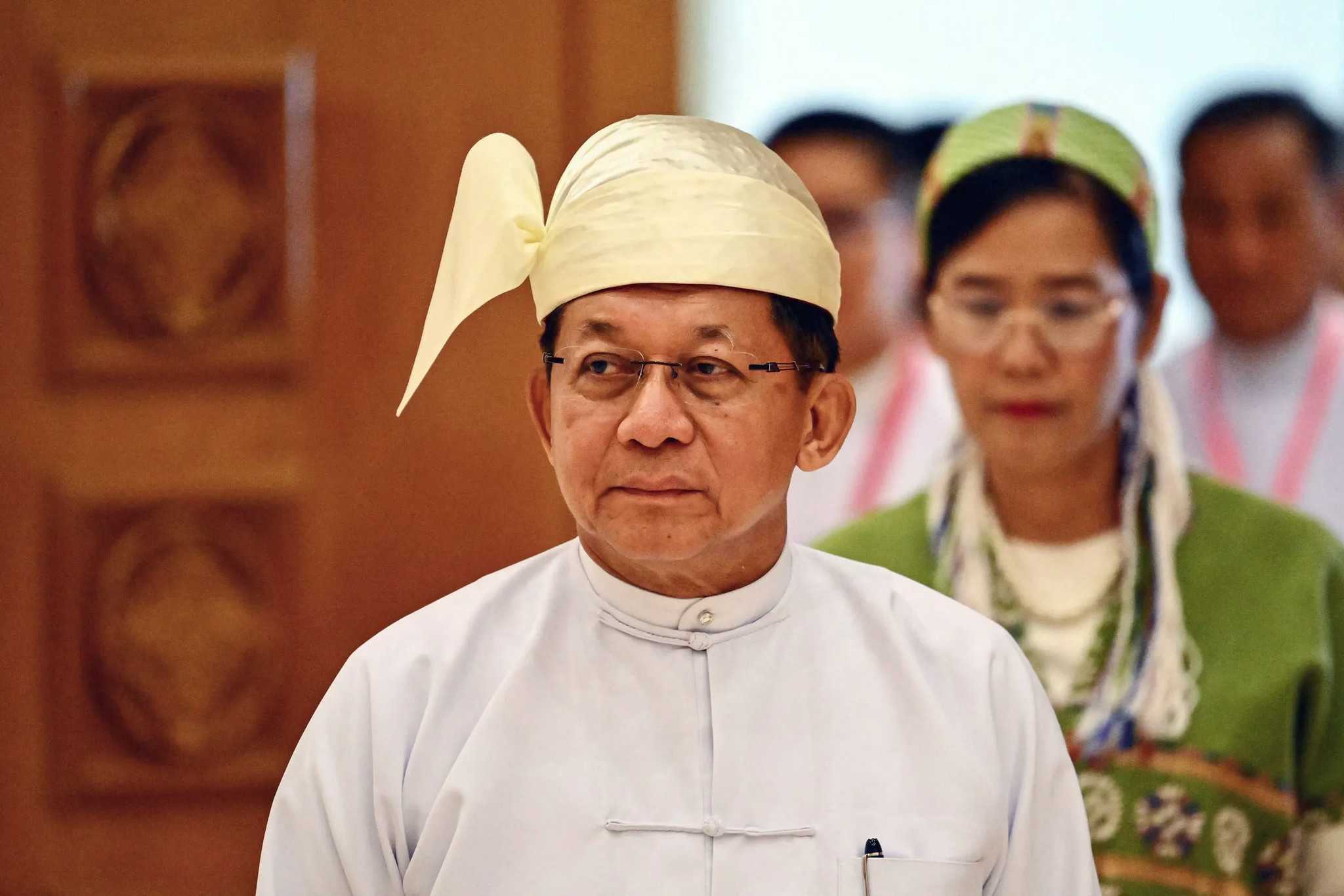


Myanmar wants to return to the diplomatic fold of Southeast Asia, but the government led by Min Aung Hlaing is discovering that access to regional leaders and acceptance by the regional bloc are not the same thing. Visits to neighboring countries, bilateral discussions and efforts to regain a place in regional forums have kept diplomatic channels open. They have not resolved the central problem behind Myanmar’s isolation since the 2021 coup: a war that continues to devastate the country and a political crisis for which no broadly accepted settlement has emerged.
On Wednesday, Min Aung Hlaing told parliament that his government was reconsidering its relationship with ASEAN while continuing talks with member states. The remarks came after regional leaders meeting in Manila this week, without Myanmar’s participation, signaled that the country could gradually regain full political representation if it made progress toward resolving the crisis. The prospect of a phased return, however, appeared insufficient to satisfy the expectations of Myanmar’s leadership, which has sought a more normal relationship with the organization.
The disagreement is about more than diplomatic protocol. Myanmar wants greater room to participate in regional affairs, while ASEAN has tied political representation to developments inside the country. That distinction reflects the unresolved question of how the bloc should engage a government that took power through a military coup and continues to fight a nationwide conflict. For Myanmar, restrictions on participation are a measure of its treatment by ASEAN. For the bloc, restoring political representation without meaningful progress risks treating the crisis as though it has receded.
Min Aung Hlaing has framed ASEAN’s approach as unfair pressure. He complained that Myanmar was being singled out and said no other member had faced comparable treatment or humiliation. His remarks cast the dispute as one over the dignity and status of a member state, shifting attention from the conditions ASEAN has demanded to the restrictions imposed on Myanmar itself. In this account, diplomatic exclusion is a grievance in its own right, rather than a consequence of the political and military crisis that prompted it.
Yet Myanmar has not been cut off from Southeast Asia. Since becoming president in April following an election widely criticized and dominated by a military-backed party, Min Aung Hlaing has visited several ASEAN countries, including Thailand, Malaysia and Vietnam. Nearly half of the bloc’s 11 members have also expanded bilateral engagement since the election. The pattern suggests that Myanmar’s exclusion from political representation at regional meetings has not translated into a uniform refusal to deal with its government.
Bilateral diplomacy serves a different purpose from participation in ASEAN’s collective forums. Individual governments can maintain communication, negotiate practical arrangements and protect their interests without endorsing Myanmar’s political transition or agreeing that the country has met the conditions for full regional participation. For neighboring states, the consequences of instability are not confined to diplomatic relations. Conflict can affect border security, displacement, trade and the wider stability of the region. Maintaining contact may therefore be a necessity, even when political recognition remains contested.
Min Aung Hlaing has said Myanmar will consider both its own position and the intentions of ASEAN members as it decides how to pursue normalization. He has also pledged to continue discussions with regional governments. The statements suggest that Naypyidaw is not abandoning diplomacy, but they offer little indication of what it might change at home to satisfy the bloc’s demands. Without concrete steps toward resolving the conflict, diplomatic outreach risks becoming an exercise in expanding relationships while leaving the reasons for Myanmar’s isolation untouched.
ASEAN, for its part, has not closed the door. Regional leaders have indicated that full political representation could be restored incrementally if Myanmar demonstrates progress toward implementing the bloc’s agreed framework for resolving the crisis. The approach, often described as calibrated engagement, allows ASEAN to adjust its level of involvement according to developments rather than make an all-or-nothing decision. Its emphasis is on sustained, tangible progress rather than gestures that can be made without changing conditions on the ground.
The distinction matters. ASEAN is offering the possibility of greater participation, not an unconditional return. Myanmar remains able to maintain bilateral ties and communicate with member governments, but its place in the bloc’s political proceedings is still subject to a collective judgment about the country’s direction. That arrangement gives ASEAN some leverage while preserving diplomatic channels, although its effectiveness depends on whether the conditions attached to engagement can produce results.
For Min Aung Hlaing, this leaves a narrow path. He can cultivate individual relationships across the region, make diplomatic visits and keep negotiations moving. Those efforts may help Myanmar maintain a degree of regional contact, but they cannot by themselves restore its political standing within ASEAN. Full representation is a collective decision, and the bloc’s position remains tied to a crisis that bilateral diplomacy cannot settle.
The obstacle lies beyond the conference rooms. Since the military overthrew Myanmar’s elected government in 2021, the country has been engulfed in a conflict involving the armed forces and a range of resistance groups. Fighting has killed civilians, displaced millions and undermined attempts to restore political stability. The government seeking regional acceptance is still a central party to a war that has made that acceptance difficult.
ASEAN’s response rests on a framework established after the coup: the Five-Point Consensus. It calls for an immediate cessation of violence, constructive dialogue among all parties, mediation by ASEAN and humanitarian assistance. The agreement was intended to create a diplomatic path out of the crisis, one that would involve the conflict’s principal actors rather than limit negotiations to the authorities in power.
But the consensus has not brought an end to the fighting. Its continued relevance, alongside the conflict’s persistence, exposes the limits of ASEAN’s approach and the difficulty of translating regional agreement into influence inside Myanmar. The bloc faces competing risks. Engagement without measurable progress could weaken its demands; pressure without effective channels for dialogue could diminish its ability to shape events.
ASEAN has sought to avoid either outcome, keeping the possibility of political reintegration open while withholding the representation Myanmar wants. The strategy may preserve room for negotiation, but its success cannot be judged by the continued existence of diplomatic contacts. The more consequential measure is whether those contacts move the country toward a settlement that makes regional normalization something more than a change in diplomatic status.
The promise of peace and the credibility of ASEAN
Min Aung Hlaing has proposed another route toward changing Myanmar’s position: a peace conference scheduled for February. He has said he wants to bring the fighting to an end during his five-year presidency, offering the prospect of negotiations at a time when the military’s campaign continues. Yet the proposal remains largely undefined. He has provided few details about who would participate, what the conference would address or how any agreement would be enforced. The announcement signals an intention to pursue peace, but the substance of the initiative remains unclear.
That uncertainty is significant because Myanmar’s conflict is not a dispute that can be resolved simply by convening its principal actors. The military faces an array of armed groups with different political objectives, territorial interests and relationships with one another. Any negotiation would have to account for those differences, including whether participants have the authority or willingness to commit the forces they represent to a lasting ceasefire. An agreement reached by some factions would not necessarily bring an end to fighting elsewhere.
The composition of the proposed conference may prove as consequential as its agenda. Which groups are invited, which are excluded and who determines the terms of participation could shape whether the process is regarded as legitimate. Groups left outside may reject the outcome, while those attending may have little incentive to accept arrangements that leave the underlying political conflict unresolved. In a war involving multiple actors, the appearance of a negotiating process is not the same as a process capable of ending hostilities.
There is also the question of trust. The 2021 coup fundamentally altered the relationship between Myanmar’s military and much of the country’s population, setting off resistance and an expanding conflict. The military is not an impartial broker attempting to bring two sides together. It is itself a combatant, and its political authority remains contested. A credible peace process would therefore require more than a declaration of willingness to negotiate. It would require commitments and actions that other parties could reasonably regard as evidence that the government was prepared to address the conflict rather than manage its political consequences.
The conduct of the war has made that distinction harder to establish. While officials continue to discuss reconciliation and an end to hostilities, the military has intensified airstrikes in several areas. Bombings, including attacks that have killed large numbers of civilians, have aggravated the humanitarian crisis. More than 100,000 people have reportedly been killed and millions displaced during the conflict. The figures convey the scale of destruction, but they cannot fully capture the disruption of communities, the loss of livelihoods or the uncertainty facing those who have been forced from their homes.
Against that backdrop, the proposed February conference faces a test that cannot be answered through diplomatic announcements. For people living in conflict zones, the credibility of a peace initiative rests on whether it changes their circumstances: whether attacks stop, whether displacement ends and whether returning home becomes possible. The government may describe negotiations as a political priority, but their value depends on what happens beyond the negotiating table.
This is also where ASEAN’s position becomes more complicated. The organization wants to preserve regional stability, maintain relations among its members and encourage a political settlement in Myanmar without deepening divisions within the bloc. Yet its members do not necessarily share the same priorities, assessments or appetite for pressure. Some may see sustained engagement with Min Aung Hlaing’s government as necessary to keep channels open, while others may be more concerned that renewed political recognition would weaken the bloc’s demands.
The difference is not necessarily between governments that favor diplomacy and those that oppose it. Bilateral engagement can be useful precisely because it allows governments to pursue practical interests and maintain communication when collective diplomacy stalls. But those contacts do not automatically produce a common ASEAN position, much less give the organization the leverage needed to alter the course of the war. Regional diplomacy can remain active even as the political problem it is supposed to address grows more entrenched.
The bloc’s calibrated approach attempts to bridge that divide. By withholding full political representation while allowing the possibility of a gradual return, ASEAN has created a conditional path rather than a permanent exclusion. In principle, that gives Myanmar an incentive to demonstrate progress while allowing member states to adjust their engagement without abandoning diplomacy. In practice, the strategy depends on a difficult balance: conditions must be clear enough to mean something, attainable enough to encourage movement and consequential enough that meeting them represents a genuine change.
Without measurable benchmarks, conditional engagement could become an indefinite arrangement in which Myanmar remains partially excluded but little changes. The government could continue to pursue bilateral relations while treating the restrictions on regional representation as a diplomatic inconvenience rather than an incentive for political reform. ASEAN, meanwhile, could find itself repeatedly reconsidering the same question without evidence that its policy has altered the behavior of those responsible for the conflict.
The opposite problem is equally real. If ASEAN’s conditions are detached from the realities of a fragmented war, the organization may demand progress that it lacks the means to secure or assess. The bloc’s reliance on consensus and the differing interests of its members limit how far it can act collectively. Diplomatic pressure is not a substitute for political leverage, and a regional organization cannot assume that withholding representation will compel a government or armed group to change its calculations.
The Five-Point Consensus remains the clearest expression of ASEAN’s intended response, but its objectives extend beyond diplomacy. Ending violence, bringing the parties into dialogue, facilitating mediation and delivering humanitarian assistance are interconnected tasks. The continued fighting demonstrates the difficulty of achieving them, not the absence of a framework. Yet a framework that remains largely unimplemented risks becoming a statement of regional intent rather than an instrument of conflict resolution.
Humanitarian assistance is particularly urgent because it cannot reasonably be made contingent on the completion of a political settlement. Millions of displaced people need shelter, food, medical care and protection. Access to those necessities must be addressed while negotiations continue, not postponed until the parties agree on the future of the country. The separation between political progress and humanitarian relief is therefore a practical necessity, even if both remain connected to the broader conflict.
For ASEAN, the challenge is to ensure that engagement serves more than the preservation of diplomatic access. Maintaining communication with Myanmar may help reduce regional risks, facilitate humanitarian efforts and create opportunities for negotiations. But communication alone is not an outcome. The bloc must also be able to assess whether its engagement is contributing to a reduction in violence or merely accommodating a conflict that continues without a credible path toward resolution.
Min Aung Hlaing’s desire for normalization is understandable as a political objective for a government seeking to expand its international relationships. Visits, bilateral talks and a proposed peace conference can all help create the appearance of renewed engagement. They may also produce practical benefits. But the restoration of diplomatic relationships cannot substitute for resolving the crisis that has made Myanmar’s political standing contentious in the first place.
ASEAN faces a similar distinction between preserving relationships and achieving its stated goals. Bringing Myanmar back into regional political forums may eventually be necessary for a durable settlement, but the timing and conditions of that return matter. Restoring full representation without meaningful progress could undermine the principle that political participation carries responsibilities. Maintaining restrictions without a credible strategy for moving the crisis forward, however, could leave the bloc with little influence beyond expressing concern and keeping the door open.
Neither Myanmar nor ASEAN has yet bridged that gap. The government has not outlined a peace process capable of demonstrating that its promise to end the war will translate into a political settlement. ASEAN has not found a way to turn its diplomatic framework into sustained progress on the ground. The two sides remain engaged, but engagement has not resolved the central disagreement over what must change before Myanmar can return to normal relations with the region.
The February conference, if it takes place, will be judged less by the fact that it convenes than by the choices made around it. The participation of relevant parties, the willingness to address the political roots of the conflict, the clarity of commitments and the ability to reduce violence will matter more than the announcement itself. A conference that excludes significant actors or produces no meaningful change could become another diplomatic exercise with little effect on the war.
Myanmar may rebuild its relationships with ASEAN members one government at a time. That process could preserve communication and gradually reduce diplomatic isolation. But normal relations cannot be restored through bilateral visits alone, nor can regional participation resolve a war that continues inside the country. For ASEAN, the task is not simply to bring Myanmar back into its meetings. It is to make diplomacy consequential enough that returning to those meetings represents progress toward peace, rather than a substitute for it.
Leave a Reply